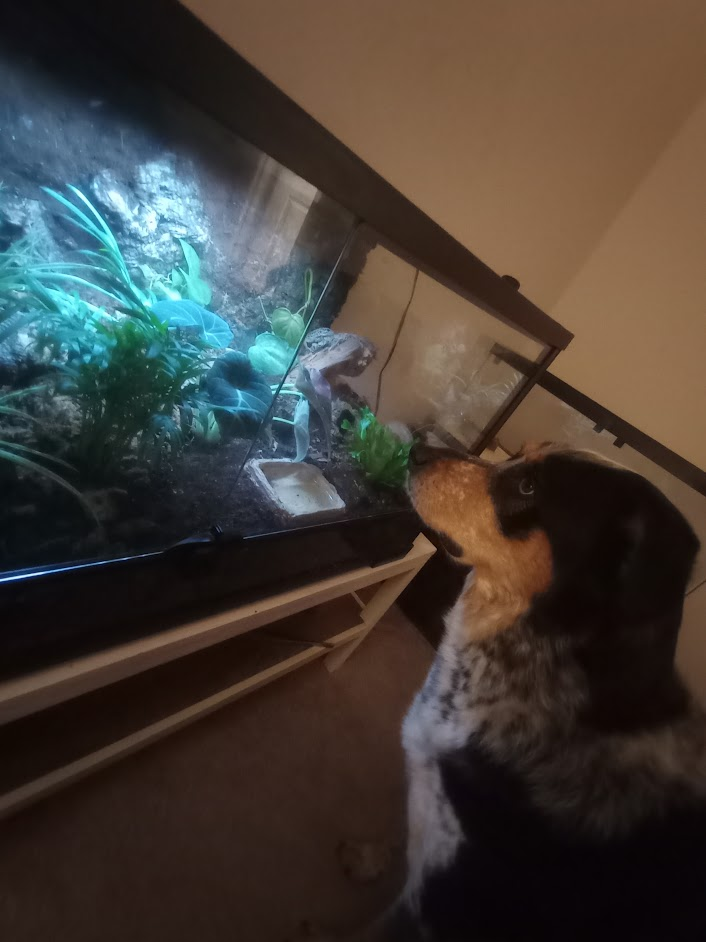
(Note: post contains a brief description of animal abuse. It has a happy ending, but still)
Jake
Here’s how it started:
I’m minding my own business in my office at home. Answering messages from puppy parents in crisis, as I do every day. Erin’s down the hall doing the work-from-home thing at her day job in animal welfare.
Suddenly, I hear the typing in the next room intensify. A furious clacking of keys. And then she starts speaking into her headset. Over the next couple hours, I absorb snippets of conversations with multiple people. Snippets along the lines of:
“Oh my god.”
“When do you need an answer by?”
“What did the vet report say?”
“What is she supposed to eat?”
“Hey, do you still have that extra reptile tank?”
Slowly, I piece it together.
There is a gecko. She is a victim of fucked up humans doing fucked up human shit; she was seized from a cruelty case where someone decided they didn’t want her anymore and literally locked her in a room to starve to death.
Fortunately, the gecko was saved before it was too late. And now the gecko is homeless.
Well. Was homeless.
A new home has been secured.
The final snippet of conversation:
-nervous laughter- “Alright, let me go talk to Jake. I’ll let you know if he divorces me.”
Pardon me?

Frankly, I’m offended at this point. It’s like you don’t even know me at all. Divorce you? Nah. Prepare to be ENABLED.
Thirty seconds later, Erin appears in my doorway.
“Yes,” I say without looking up from the computer. “You can have the lizard.”
“That’s good, because I said I’d pick her up tomorrow.”
And here we are, almost two months later.
Everyone, meet Joanna.
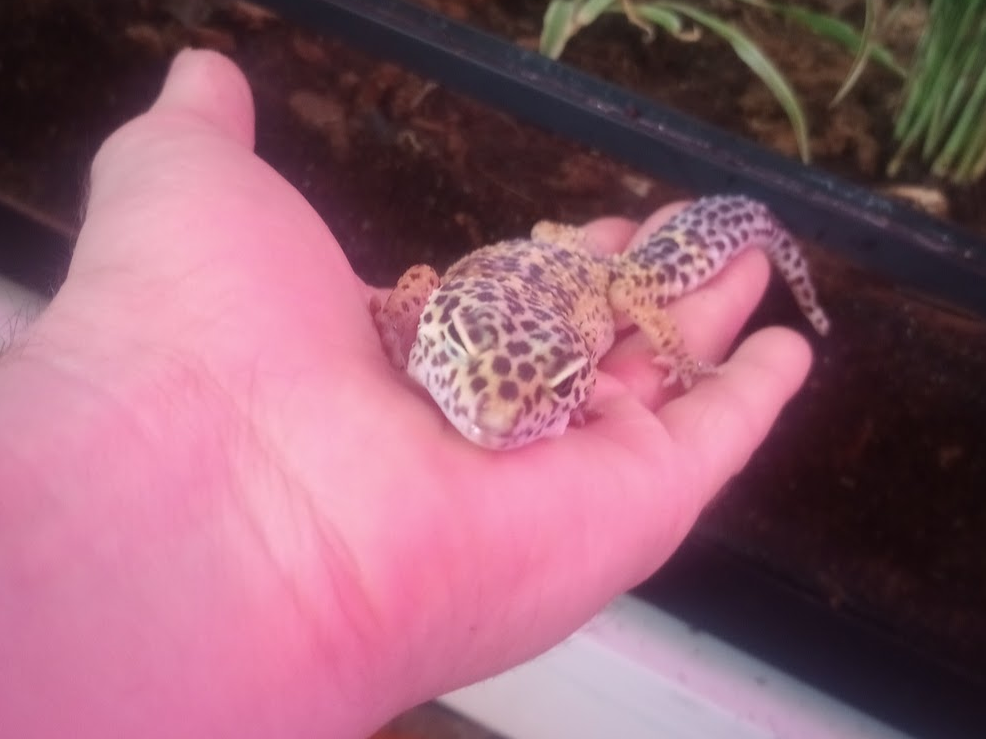
(We named her after Joanna the Goanna from Rescuers Down Under, a core part of Erin’s childhood)

This experience has made me all the more understanding of what our members go through with their dogs.
Because I remember the first 24 hours after learning of Joanna’s existence. Bit of a whirlwind.
Neither of us knew anything about reptiles. I went to Instagram first, just to start getting my bearings (I literally didn’t even know what a leopard gecko looked like. THAT’S how much of a beginner I was). I found a bunch of reels from people who sure sounded like they knew what they were talking about, saying things that sure sounded reasonable to my untrained ears.
Right.
Forgive me if spending 20+ years in the hellscape of the dog training industry has left me… skeptical/traumatized.
Do these people know what they’re talking about, or are they just really good at social media? Are they giving advice that’s legit, or forty years out of date?
(Don’t get me wrong, I’m sure plenty of them were great! I’m just not blindly taking the word of the first “expert” the algorithm throws at me, is all I’m saying)
Later, we went to the pet store to gather supplies. Erin had a headstart in the research department, so she was less clueless than I was. But I’m standing there staring at shelves full of stuff wondering “does she need this? Or that? What about this? Is this a smart purchase… or is this one of those products that every experienced keeper knows is terrible?”
After we got home, I set up her heat lamp according to the instructions on the package. Three hours later I went online again and discovered, to my embarrassment, a pretty clear consensus: no one sets them up that way because it’s actually pretty dangerous and ineffective.
I’m guessing all of this sounds pretty familiar, huh?
It’s funny – as I was standing in the reptile section of the pet store, noticing for the first time all these products I’d spent decades walking past on my way to the dog section, all I could think about were all those messages from puppy parents in crisis.
As dog trainers, we spend so much time helping people navigate the noise that it’s easy to forget how overwhelming it is when you don’t know what you don’t know.
It’s probably been good for us to remember what that feels like.
We do have one advantage, though: even though we’re new to reptiles, this ain’t our first rodeo. We know how to evaluate information in the pet world.
Erin wrote up an explanation of the process she used while researching leopard gecko care, and we thought it might be interesting to share because it’s the same kind of process we hope people use when they’re trying to navigate the overwhelming world of dog training.
Take it away, Erin:
Erin
“She’s very friendly, and I think it would be a shame for her to not go to a home with someone who’ll care for her. If anyone wants her, let me know.”
I read the email and before I’d even registered what I was doing, I shot back my reply:
[Editor Jake: ah, that must have been the furious typing I heard]
“Hi! I’d love to take her. When can I come and pick her up?”
“Tomorrow.”
Immediately, I looked for videos (I’m a visual learner, for sure) about keeping leopard geckos. Not only have I never owned a gecko before, but I’ve never owned a reptile at all. I was looking for the absolute basics: what do they eat? Where do they spend their time? Do they drink water? Do they swim?
And very quickly I was reminded of what it felt like to get my first dog, because everywhere I looked there was competing advice and a whole bunch of people yelling at each other over the internet.
Some people said they shouldn’t have any humidity at all, because they live in the desert. Others said they needed some humidity – but not too much or else they’ll die.
Some said use a separate heat element. Others said to combine it with light. Some people had red lights at night to help them see – others said this would destroy their colour vision.
Everyone was very passionate, and I was very confused. And worried. What if I listened to the wrong person, and this poor gecko – who’d already been through so much – suffered?
But I’d done this before, with dogs: I’d heard all the competing advice, and I’d sought out a robust education in the history of dogs, their genetics, and how their natural history affects their welfare and behaviour. I’d untangled this net before.
So I looked at my lizard, and thought like a dog trainer.
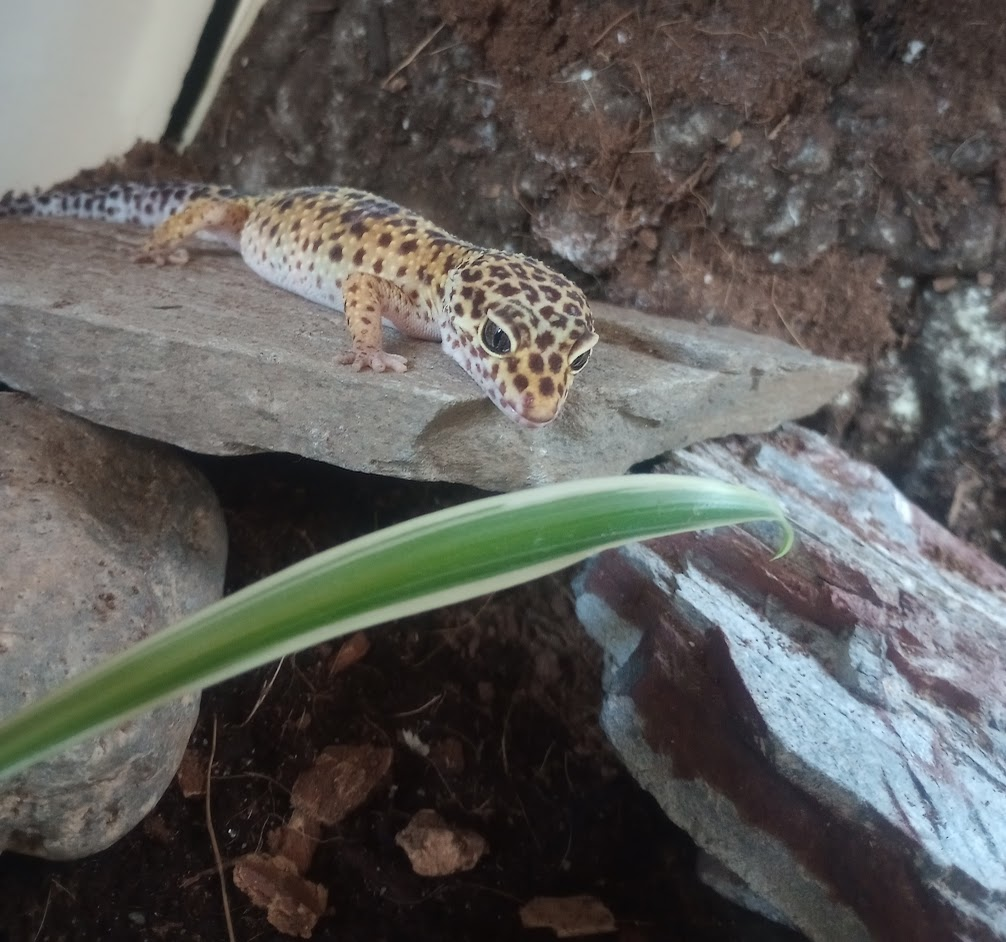
Her markings – camouflage; a costume that evolved so specifically to keep her safe – didn’t look all that much like a desert to me. It looked like dappled light through leaf litter.
I went looking for photos of leopard geckos in the wild and, lo and behold, we barely have any. There weren’t many people who had gathered information about this specific type of leopard gecko, but if I was going to understand how to take care of her, I needed to understand where she came from.
As it turns out, geckos like her are found in ecosystems that are about as different from each other as you could imagine. Some live in deserts, yes – but those deserts receive a large amount of moisture through fogs and mists that descend in the evening and early morning. Others were found in mossy rock walls dripping with water after tropical monsoon rains. More, still, were found in lush woodlands, living in thick leaf litter, retreating up dead trees for refuge when the forest floor became flooded.
I learned that leopard geckos can be fantastic climbers, excellent ambush predators, and clever escape artists when they find themselves in trouble.
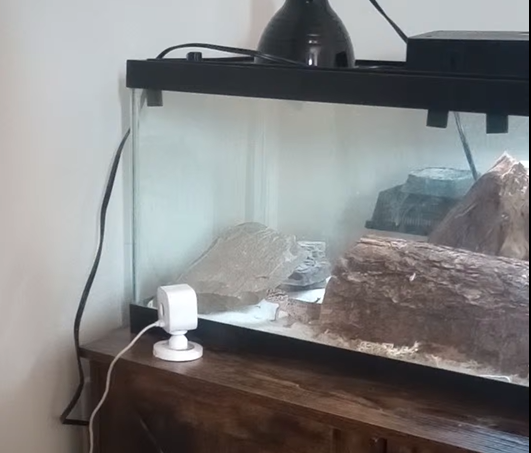
I set about redesigning Joanna’s enclosure to give her as many choices of temperature, humidity, and elevation as possible in order to approximate the ecosystems available to her in the wild.
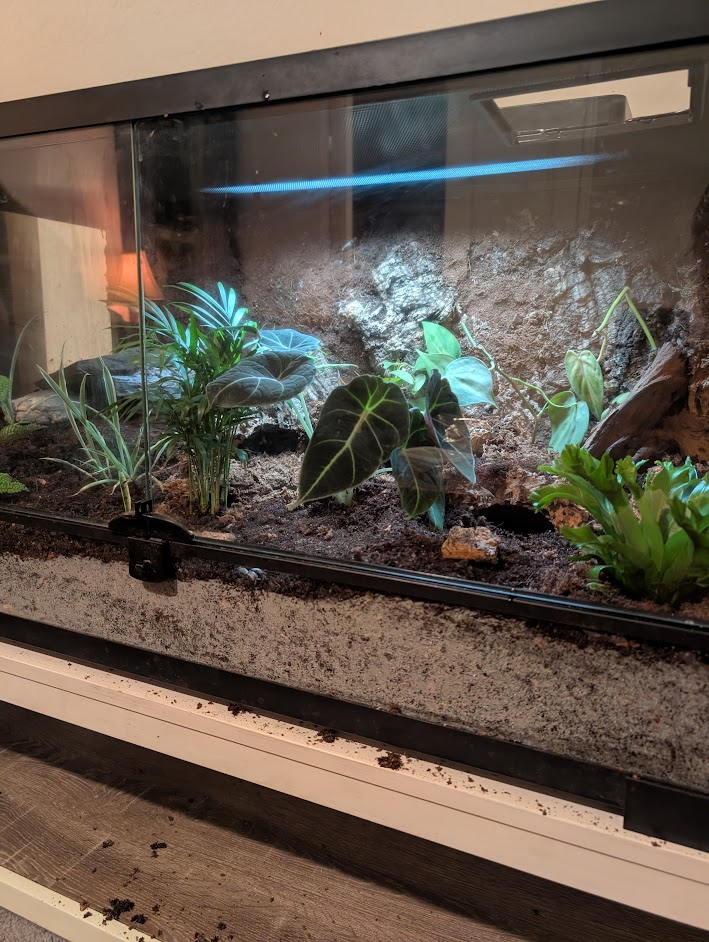
Because of my education as a dog trainer, I didn’t approach learning about Joanna through the lens of a pet; I looked at her as the captive animal that she is, not too far removed from her cousins in the wild.
My choices in caring for her have revolved around providing her opportunities to feel normal. To do what hundreds of thousands of years of evolution urge her to do.
Sometimes, that means I ask to pick her up, and she says no. Despite being a very sweet lizard who’s extremely handleable, she isn’t always feeling up to it: she could be sleeping in her warm basking cave and doesn’t want to be bothered; or my hand coming through the top of her enclosure could remind her of her natural predators, who swoop down from the sky to snatch her.
More often, it means that she runs to the front of her enclosure as soon as she sees us come in the room, demanding more waxworms. (Waxworms are basically junk food and she can’t have them very often)
And in the most recent development, sometimes it means she climbs into our offered hand and settles in. Humans make good portable heated rocks, she’s discovered.
Animals – dogs or not – may come into our lives as pets that we project all sorts of desires on to: companionship, obedience, power, or love.
But they don’t know any of that.
All they know is who they are, and what their nature asks of them. It’s our job as their caretakers and – in the case of our dogs, their family – to put aside the needs we hoped they’d fulfill for us, and help them be the loudest, biggest, most true versions of themselves that they can be.
Even if that’s a funny, greedy little lizard.